
When organizing an event, one of the first questions that arises concerns ticketing costs.
- How much does a platform really cost?
- What are the percentages charged?
- Are there any hidden fees?
- Do I have to pay a monthly subscription?
- Can the costs be transferred to the buyer?
- …
Behind these questions lies a key issue: the profitability of the event.
A poor understanding of the pricing structure can significantly reduce margins or create financial surprises at the end of the event.
The Belgian online ticketing market currently offers several business models. Understanding these models, knowing how to compare them, and analyzing their concrete impact is essential for making an informed decision.
The main fee models in Belgium
In Belgium, most ticketing platforms operate according to one of the following three models : simple commission, commission combined with a fixed fee, or monthly subscription.
The simple commission model involves taking a percentage of each ticket sold. This percentage generally varies between 1.5% and 5%. It may seem attractive, but it does not always represent the final cost.
The most common model combines a percentage and a fixed fee per ticket. For example, a platform may charge 2% of the ticket price, plus €0.60 per ticket.
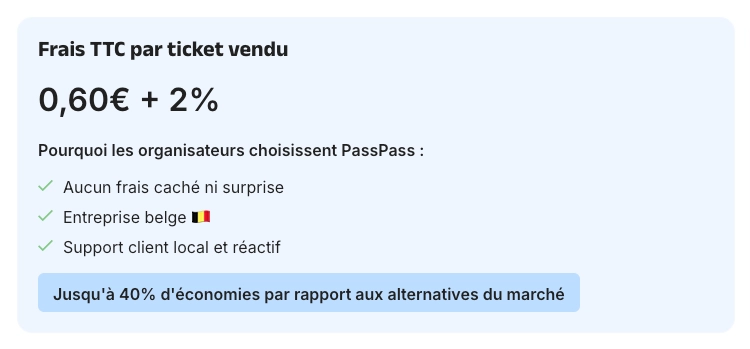
This structure is often more transparent because it allows for immediate calculation of the cost per sale.
Finally, some solutions offer a monthly subscription. In this case, the organizer pays a fixed amount each month, to which a small commission may be added. This model can be attractive for organizations that hold many regular events, but it represents a financial commitment that is independent of sales volume.
The actual cost: why the percentage shown is not enough
A common mistake is to compare only the percentage advertised by the platforms. However, the actual cost must be analyzed in a concrete scenario.
Let's imagine an event that sells 800 tickets at $30 each.
- With a commission of 3%, the total cost amounts to €720.
- With a structure combining 2% and a fixed fee per ticket, the result depends on the exact amount of the fixed fee. Depending on its level, the total cost may be slightly lower or higher than the 3% model.
- In the case of a monthly subscription combined with a reduced commission, the calculation will depend on the number of events organized during the year and the total volume sold.
These variations show that a single percentage is never enough to compare two solutions. The right approach is to simulate your own real-life situation: average ticket price, estimated volume, number of annual events.
A platform may seem cheaper at first glance but become more expensive depending on the overall cost structure and event configuration.
Payment and transaction fees
Beyond the main commission, you need to consider the fees associated with payments. Some platforms include bank processing fees in their overall commission. Others charge them separately.
These fees generally cover the costs of payment networks (Visa, Mastercard, Bancontact, etc.) and transaction security. Their structure may vary depending on the payment method used.
In Belgium, the presence of local solutions such as Bancontact can influence the conversion rate. It is therefore important to check whether these methods are included and at what cost.
Transparency regarding these fees is a key indicator of reliability.
Can the costs be transferred to the buyer?
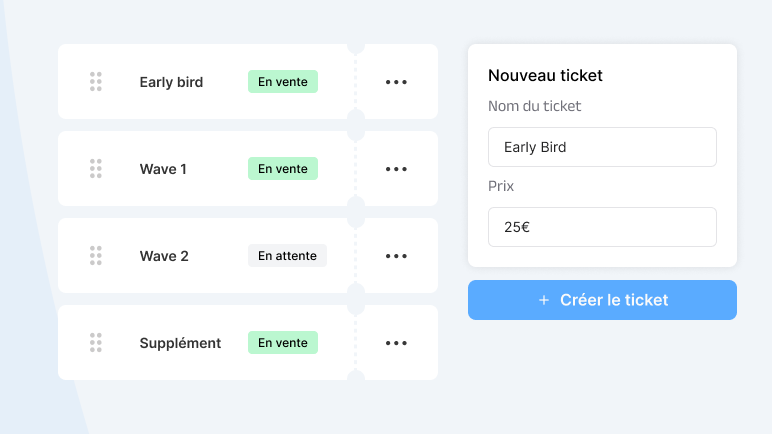
A frequent question among organizers concerns the possibility ofpassing on ticketing costs to participants. In Belgium, many platforms offer this option.
In practical terms, the ticket price remains set by the organizer, while service fees are added at the time of payment. This allows margins to be maintained.
However, this strategy must be carefully considered. A higher final price may influence the participant's perception. The impact on the conversion rate depends on the type of event and the target audience.
A flexible platform gives the organizer a choice.
Often overlooked additional costs
When comparing solutions, several secondary factors deserve special attention.
Some platforms charge fees for refunds or cancellations. Others impose costs for data export or access to advanced reports. Marketing modules, seating plans, or specific integrations may also incur additional charges.
These elements do not always appear in the initial commercial communication, but they influence overall profitability.
Comparing fees therefore involves analyzing all of the terms and conditions.
VAT and administrative obligations in Belgium
In Belgium, VAT management is a key issue. Depending on the nature of the event and the status of the organizer, different rates may apply.
Some platforms simplify automatic VAT calculation and generate structured financial reports. Others leave part of the management to the organizer.
For companies and non-profit organizations, the ability to export data compatible with Belgian accounting standards is a significant advantage. Administrative compliance can prevent extra work at the end of the fiscal year.
A solution tailored to the local environment simplifies post-event management.
The link between cost and service quality
It may be tempting to choose the platform with the lowest commission. However, cost should not be analyzed in isolation.
- Ease of use
- speed of posting online
- technical reliability
- the quality of the support
- access control management on the day
…also have economic value.
A slightly more expensive but more intuitive platform can save several hours of administrative work. For a major event, this time saving can more than offset the difference in commission.
Value for money therefore remains a key criterion.
What is the most common structure in Belgium today?
In Belgium, the online ticketing market is evolving towards simpler and more transparent models.
Rather than a fixed monthly commitment, the most popular model is based on a combination of a moderate percentage and a fixed fee per ticket sold. This approach has one major advantage: it makes the cost immediately predictable.
For example, a structure of around 2% + €0.60 per ticket allows you to calculate the total cost of an event in just a few seconds.
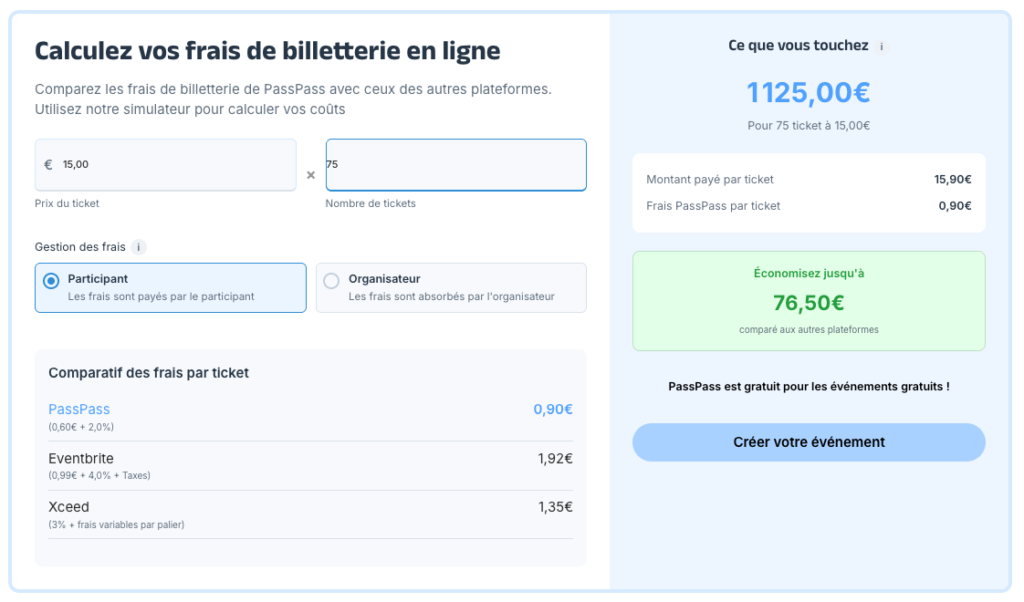
This is precisely the approach taken by PassPass: transparent pricing, no monthly commitment, suitable for one-off events and recurring organizations.
Why pricing simplicity is strategic
A clear pricing structure facilitates communication with partners, price setting, and budget forecasting. It also reduces internal friction within the organization.
For independent organizers, SMEs, and associations, transparency of costs is often more important than a slightly lower percentage.
A platform designed for transparency enables quick and rational decision-making.
Conclusion: how can you effectively compare fees?
The costs of an online ticketing system in Belgium vary depending on the model chosen:
- simple commission
- commission combined with a fixed fee
- monthly subscription
To make an informed decision, it is essential to simulate a real scenario, analyze the associated costs, and verify the overall transparency of the platform.
Beyond the percentage displayed, simplicity, local compliance, and the quality of support must be factored into the equation.
A clear and predictable pricing structure is often the best choice for selling tickets with peace of mind and optimizing the profitability of an event.