
How to print badges for your event in 2026
On-site or pre-printed badges, equipment, workflow, formats. Practical guide to event badge printing.
6 min read
It's 8:45 am. The first attendees arrive and your team is digging through a stack of 300 badges sorted alphabetically. One attendee spells out their name, twice. Another isn't on the list because they registered the day before. The queue grows, smiles fade.
Most organisers have experienced this scenario at least once. The good news is that there are now simple ways to avoid it. Have a badge project? Request a free quote.
Why a badge changes the dynamics of an event
From 50 attendees, a name badge transforms the welcome experience. First name, last name and company are visible at chest height. Conversations start without the classic "sorry, who are you again?".
At a seminar or conference, the badge also solves an operational problem. A colour code or printed label distinguishes speakers, press, VIPs, exhibitors and staff. Your teams identify each profile at a glance, without checking a paper list.
For larger professional events, the badge can also serve as an access pass. A QR code printed on it replaces the wristband or stamp, and provides precise tracking of entries and exits.
Pre-printed or printed on site
Two approaches coexist, with very different logics.
The pre-printed badge is ordered from a printer. You need to plan for logistics lead time: send the attendee list several days before the event, wait for printing, then collect the badges or have them delivered. This chain forces you to freeze your list early. Its weak point: every no-show after submission produces an unused badge, and every late registration produces a missing badge that has to be managed by hand on the day.
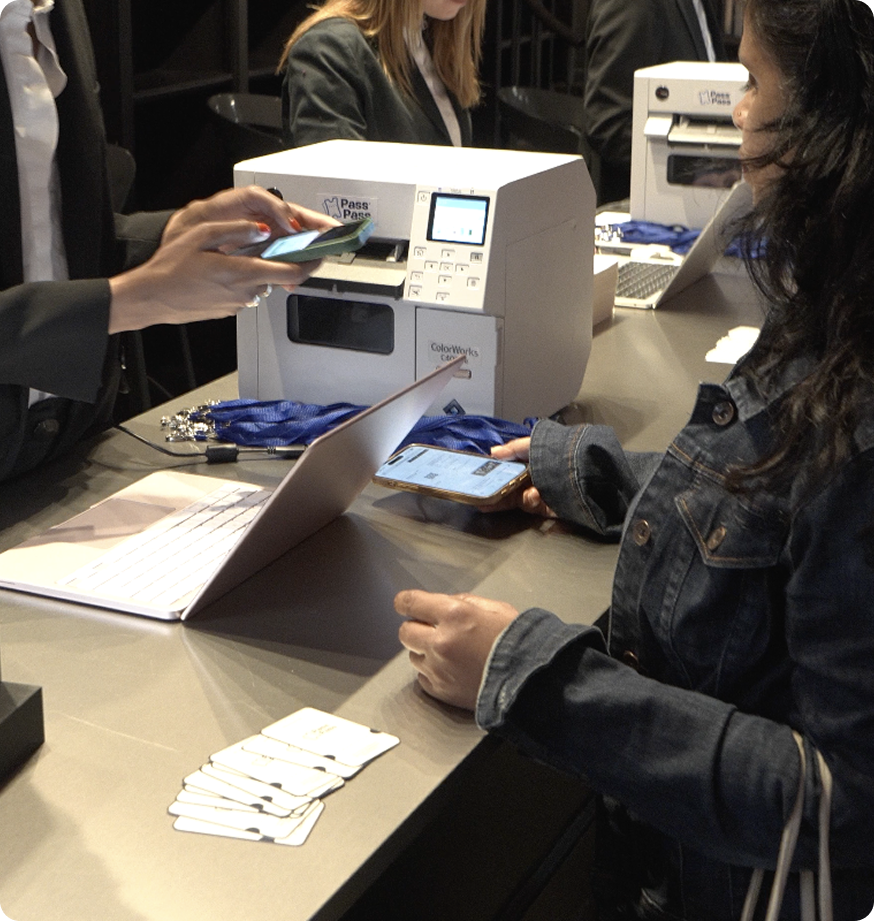
The on-site printed badge is produced the moment the attendee arrives. They present their ticket, the badge comes out of the printer in seconds. Nothing to sort beforehand, no surplus, no shortfall. This is the approach adopted by the majority of trade shows and exhibitions and professional events today.
The choice depends on your context. If you have 40 confirmed attendees three weeks ahead and zero last-minute registrations, pre-printing works and remains the most cost-effective option since there is no printing equipment to rent. In all other cases, on-site printing avoids unpleasant surprises.
The practical workflow
The attendee arrives and presents their QR code, on a smartphone or paper e-ticket. Your team scans the code with a phone or tablet. The printer retrieves the registration data and produces the personalised badge. The whole process takes less than ten seconds.
With an Epson event printer, throughput reaches about 100 badges per hour per station. For a 500-person event with arrivals spread over 1.5 hours, three printing stations are enough to handle the flow without queues.
If you use PassPass for online ticketing, your data is synced directly with the dashboard. An attendee who registers minutes before the event or at the front desk appears immediately in the attendee list and in the scanning app. Their badge can be printed straight away. Manual additions are synced in the same way. The person at the desk checks the data on screen, adjusts a name or detail if needed, and starts printing.
Badge formats and customisation
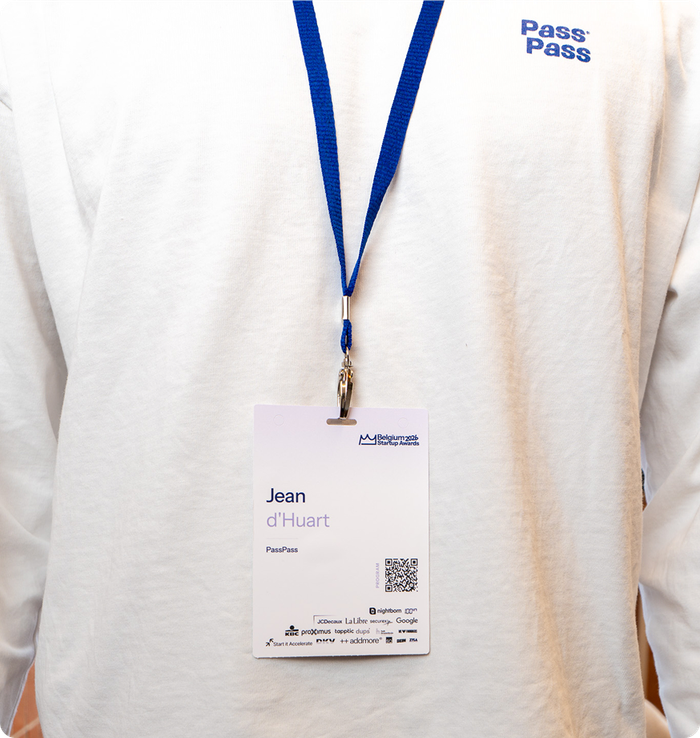
The most common format is 86 × 54 mm, the same size as a business card. It fits into a standard badge holder and works for most conferences and seminars. For trade shows or events with more information to display (programme, access zones, large QR code), the A6 format provides more space.
The information printed depends on your registration form. First name, last name, company and role are the basics. A QR code can serve as a contact card that other attendees scan, or as an access pass for multi-day events. If your form includes custom fields (department, chosen sessions, dietary requirements), this data feeds directly into the badge with no re-entry needed.
The design follows your event’s visual identity. Colours, typography, logo, and if needed a colour code by profile to distinguish speakers, press, exhibitors and VIPs at a glance. PassPass can create the design or integrate artwork provided by your designer.
Pre-perforated paper replaces PVC plastic, costs less and is recyclable. On-site printing also eliminates waste from no-shows, since only badges for attendees who are present are produced.
The equipment you need
Three elements must work together for on-site printing to go smoothly.
The event printer. PassPass uses Epson printers designed for continuous badge printing throughout the day. They handle text, logos and QR codes without loss of quality, even after several hundred prints.
Pre-perforated paper. Sheets with pre-cut badge slots, available in matte or glossy finish. Several formats exist depending on the badge size required. Paper replaces PVC plastic: it costs less, is recyclable, and suits the vast majority of events.
Accessories. Lanyards, clips, badge holders. These items can be purchased separately or received in a complete kit with the printer.
Renting a complete kit (printer, consumables and accessories) is the most common option. It is available by the day, weekend or week, depending on the duration of your event.
Badge printing in Belgium
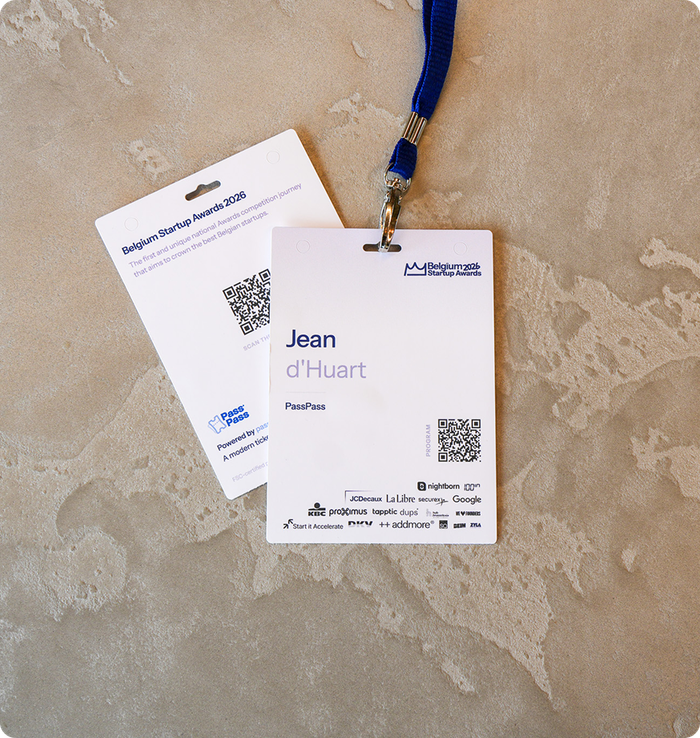
PassPass supports events of all sizes across Belgium and beyond. Congresses, corporate conferences, trade shows, seminars, gala evenings, team buildings. Equipment is delivered to the event venue anywhere in Belgium and in neighbouring countries.
On-site printing is particularly suited to events where registrations keep coming in until the last moment. This is the case for most conferences and trade shows in Belgium, where a significant share of attendees register in the final days.
The service scales to fit your event. The number of printing stations and consumables is sized according to the expected arrival flow.
Setup and lead times
Printer rental and delivery take just a few days. On-site setup is quick. Plug in the printer, load the paper, connect to the network, run a test. A station is operational in about twenty minutes.
The only element that requires planning ahead is customised lanyards. Production takes around 10 working days, plus delivery time. If you opt for standard lanyards, they are available immediately with the kit.
Have spare paper and ink on hand. Beyond 300 attendees, double the printing stations to maintain a fast flow.
PassPass offers several levels of service depending on your needs. Equipment delivery only, or full support with badge design, installation and on-site assistance. The service is available in Belgium and neighbouring countries.
Frequently asked questions about badge printing
There's no strict minimum. Badge printing is most useful from around 80 to 100 attendees, when managing pre-printed badges becomes time-consuming. For very small events, simple name stickers may be enough.
No. PassPass can print badges from an attendee list provided as a file. The integration is simply smoother if you also use the ticketing system, since data syncs automatically. If you use another ticketing platform, it's worth checking whether it has the right tools and connectors to streamline the badge printing workflow.
Yes. Badges can include validity dates, specific days, or access levels. They can be printed on first arrival and remain valid for the entire event.
PassPass always provides backup equipment on site. If a printer fails, it's replaced immediately so that attendee flow is never interrupted.
The price depends on the number of attendees, the badge format, and how many days the event lasts. Contact us for a personalised quote.
Yes. PassPass can supply lanyards and badge holders, whether simple or customised to match your event's branding. These accessories are available on request and quoted separately.